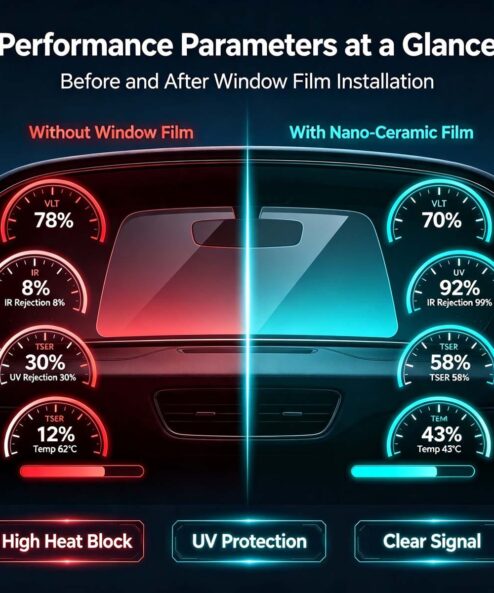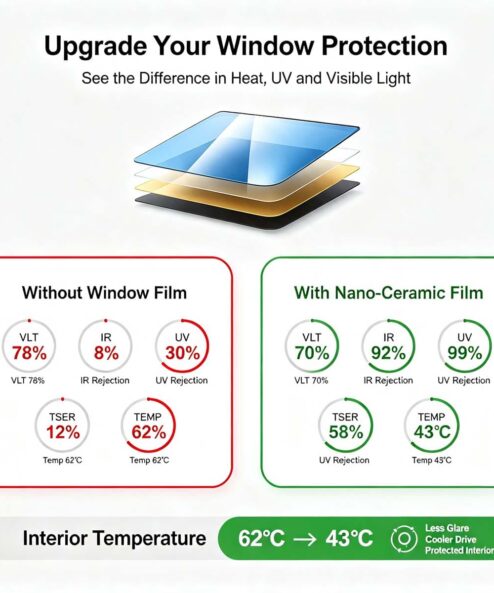
Car window film is a polyester tint applied to side and rear glass to cut heat, glare and UV. Shimao supplies nano-ceramic, dyed and carbon rolls in 1.52 m width; ceramic grades reject up to 99% of UV and more than 60% of total solar energy while staying within 5–70% VLT.
Which VLT is legal for car windows?
Rules differ by market: many countries allow 35–70% VLT on front side windows and 5–35% on rear glass, and some ban windscreen tint entirely. Check the local traffic regulation before ordering, because a 5% limo tint is legal on rear glass in one country and a fine in the next. Matched front and rear shades sell best.
Ceramic vs dyed tint: what is the difference?
Dyed film absorbs heat in the polyester and can fade to purple after 3–5 years. Nano-ceramic film uses non-conductive particles that block infrared without metal, so it keeps signal transmission for phones and GPS and holds colour for 8–10 years. Carbon sits between the two on price and performance.
How much heat does car film actually reject?
Total solar energy rejected (TSER) runs 35–45% for dyed film, 50–60% for carbon and 60–70% for nano-ceramic. On a 35 °C day the cabin of a tinted car can be 8–12 °C cooler after an hour in the sun. UV rejection of 99% also protects dashboard plastics and leather from cracking.
Reference material: SAE International sets the automotive glazing and material standards, and Window Film Magazine tracks tint regulation and installer practice.