
PPF Guide
Satin White Vinyl Wrap: Finish, Specs & Buyer Guide

Oct
Satin white is a soft-sheen white finish that reflects light gently instead of bouncing it back like gloss or killing it entirely like matte. On a car, it reads as a clean, modern pearl — bright in daylight, softly luminous under streetlights, and forgiving with dust and fingerprints. That balance is exactly why satin white has become one of the most requested finishes in both vinyl wrap and satin PPF programs.
This guide walks through what the finish actually is, how a typical satin white film is specified, what to check before you buy, how installers work with it, and why two rolls with the same color name can behave completely differently in the shop.
What a Satin White Finish Really Looks Like
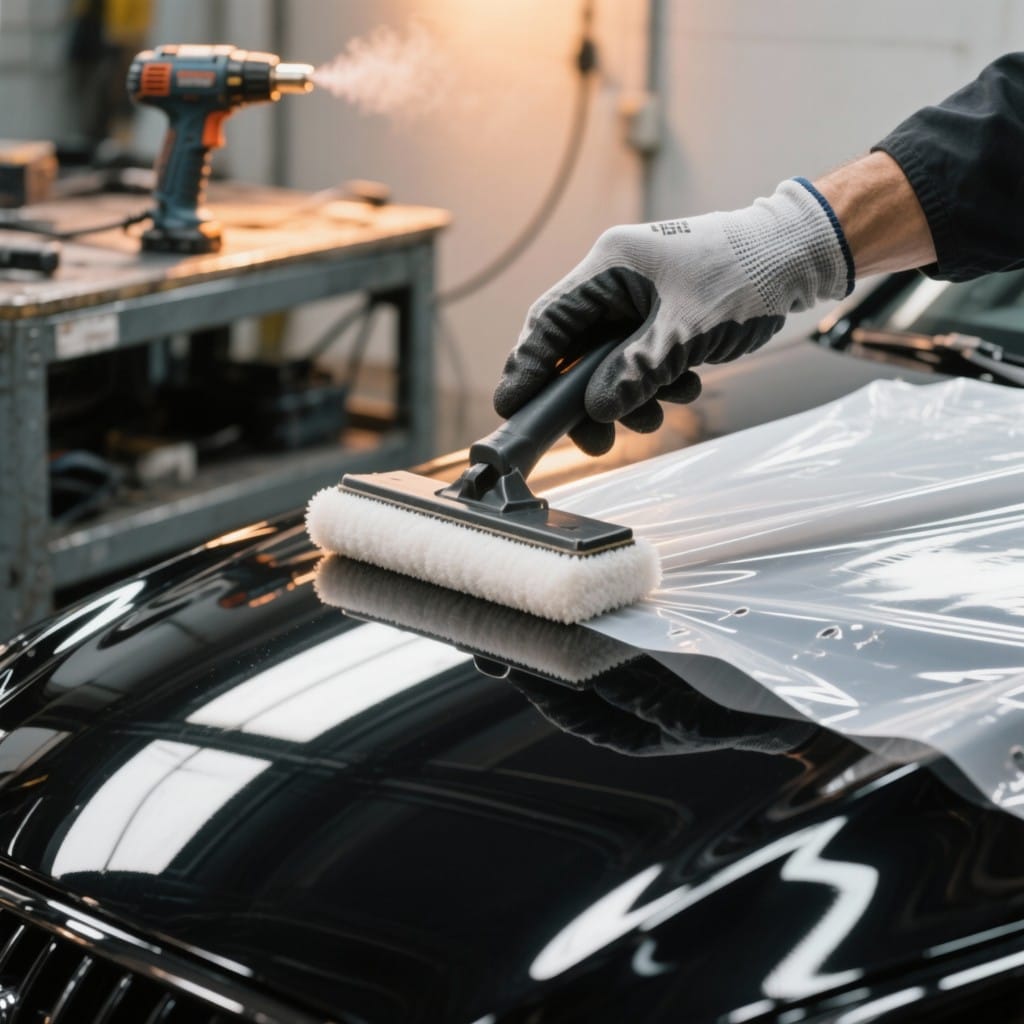
Think of the difference this way: gloss is a mirror, matte is chalkboard, and satin is the surface of a pearl. Light hitting a satin panel scatters across a narrow cone — enough sheen to show body lines and depth, not enough to expose every swirl and oil smudge.
That’s not an accident of formulation. The sheen comes from the topcoat: manufacturers disperse fine matting agents into the clear layer and control the surface micro-texture during production. Get the dispersion right and the film reads evenly from every angle. Get it wrong and you see cloudiness, patchy sheen, or a grey cast over what should be a bright white.
White is also the least forgiving base color for this trick. Any yellowing in the adhesive, any inconsistency in the pigment batch, any contamination under the surface — a satin white shows all of it. Gloss hides sins; satin white audits them. It’s the reason serious buyers judge a supplier by this specific color before they trust them with anything else.
Product Snapshot: Satin White Wrap (Shimao CK903-Class)
Shimao produces a satin white wrap in this category as an OEM/ODM manufacturer, supplying film to distributors and brands under their own labels as well as under Shimao’s naming. The specification below reflects the typical construction of a cast satin white vehicle wrap of this class — always confirm exact values on the current technical data sheet before committing to a project.
| Attribute | Typical Specification |
|---|---|
| Product code | CK903 (satin white) |
| Film construction | Cast vinyl, white pigmented layer |
| Finish | Satin / low-sheen soft white |
| Thickness | ~6.5–8 mil including adhesive (per TDS) |
| Adhesive | Pressure-sensitive, low-tack, air-release channel |
| Release liner | PET or double-sided silicone coated paper |
| Roll sizes | Commonly 1.52 m × 18 m per roll |
| Durability (outdoor) | Typically 3–5 years depending on climate and care |
| Service temperature range | Roughly -30 °C to +90 °C once applied (manufacturer data) |
| Stretch capability | Moderate heat stretch for convex and concave panels |
Numbers shift between production runs and product generations, so treat the table as a buying framework rather than a datasheet. Ask the supplier for the current TDS and a sample panel before any fleet-scale decision.
Key Attributes to Check Before You Buy
Sheen uniformity. Lay a sample on a flat dark surface and walk around it under different light sources. A good satin white holds the same soft glow at every angle. If one panel edge glows and the middle goes flat, the topcoat dispersion is inconsistent — that inconsistency will show across a full vehicle.
True white, not warm white. Whites drift. Some batches read slightly cream or grey. If you’re matching a customer’s existing trim, wheels, or a second vehicle in a fleet, request the color standard and check samples from the same production lot. Industry practice for color-critical work is to source the full job from a single batch.
Adhesive behavior. Low-tack, repositionable adhesive with an air-release channel is the shop standard. It lets installers lift and re-lay during positioning without leaving stripes, and the micro-channels bleed trapped air out during squeegeeing. A cheap adhesive grabs too early, stains the panel on removal, or leaves adhesive residue that costs you labor to clean.
Conformability. Satin whites need enough stretch to wrap mirrors, bumpers and deep concave channels without thinning out or whitening at the stretch point. Ask the supplier for the maximum recommended heat-stretch percentage and test it yourself on a scrap piece — over 20% stretch, does the surface sheen stay even?
Removal. A properly formulated cast wrap should remove cleanly from OEM paint within its service life, typically with gentle heat. This matters more than most first-time buyers realize: the cost of a bad film isn’t the film, it’s the adhesive removal labor and, worst case, the repainting.
OEM Matching and Where Satin White Is Used
One frequent request from body shops and restorers: matching a factory color. Some OEMs have offered white finishes in the satin family on limited editions and special-order vehicles, and owners of those cars come to wrap shops when a panel is damaged and repainting the whole car isn’t an option. A well-matched satin white wrap can blend a repaired section or reskin the entire vehicle for consistency.
Honest caveat from anyone who’s done this work: a vinyl wrap will not be a perfect 100% match to factory paint under every light. It can be extremely close — close enough that most observers can’t tell — but side-by-side in raking sunlight, a trained eye may spot the difference. Set customer expectations early. For full-vehicle reskins this is irrelevant; for single-panel patches it deserves a conversation.
Beyond repairs, satin white suits a wide range of uses. Daily drivers wanting a clean, low-maintenance look. Commercial fleets running white vehicles that need paint protection film performance with a premium sheen — fleet paint protection film in satin white keeps brand liveries looking uniform. Motorcycles, helmets, interior trim, architectural accents on metal surfaces, even appliances and electronics enclosures for prototype work. The finish photographs beautifully, which is why detailing studios and content creators favor it.
How It Performs in the Field
Durability data on quality cast wraps generally points to 3–5 years of outdoor service in temperate climates, with hot, high-UV regions shortening that window (manufacturer data; real-world results vary). Maintenance is straightforward but specific:
- Hand wash with pH-neutral soap; avoid abrasive brushes and automated car washes with hard bristles
- Wipe bird droppings, tree sap and fuel spills promptly — satins stain more visibly than gloss if contaminants bake on
- A sealant or ceramic coating rated for matte and satin finishes adds a sacrificial layer and eases cleaning
- Park shaded where possible; UV is the primary aging driver for any vinyl
Used sensibly, a satin white vehicle stays presentable for years with nothing more than regular gentle washing.
Application: What Installers Should Know
Satin white is considered an intermediate-level film — easier than deep-color satins that show stretch marks, harder than forgiving matte blacks. A competent wrap shop working with two experienced installers typically completes a full sedan in one to two days. The process, compressed:
- Prep. Decontaminate the paint — wash, clay bar, isopropyl wipe. Any bonded contaminant becomes a permanent bump under the film.
- Disassemble where sensible. Badges, door handles, lights where practical. Film over removed hardware looks factory; film stretched around them looks wrapped.
- Cut patterns generously. Oversize every panel; trim after the film has relaxed and settled.
- Position with low-tack adhesion. Float the film, align seams and panel gaps, then lock one edge and work outward.
- Heat and stretch into recesses. Moderate heat, even tension. Overheating whites risks a slight gloss shift at the stretch point — keep the heat gun moving and work in the film’s stated range.
- Post-heat every edge and recess. This is the step that separates a two-year wrap from a five-year wrap. Edges that weren’t post-heated lift first.
- Trim, seal, inspect. Wrap cut edges where the customer wants maximum longevity, and inspect under multiple light angles before handover.
Waiting 24–48 hours before washing lets the adhesive fully bond — standard practice across the wrapping industry.
The Disclaimer Every Buyer Should Read
Here’s the part suppliers don’t print on the box, and the part you should demand in writing. Film disclaimers on technical data sheets exist for good reasons, and they typically cover the following points — read yours before purchase, not after a problem:
- Color variation between batches. Whites are batch-sensitive. Panels from different lots may not match. Buy the whole job from one batch or accept the risk.
- No warranty on third-party installation. Film performance assumes correct surface prep and application per the manufacturer’s installation guide. A wrap applied over wax, silicone or failing clearcoat voids any coverage.
- Substrate condition. Film is not a repair product. Applying it over chipping, peeling or freshly repainted (uncured) paint will telegraph those defects and can pull paint on removal.
- Environmental limits. Chemical exposure, pressure washing at close range, and abrasive washing are outside normal service conditions.
- Images versus reality. Product photos and videos approximate the finish; screens can’t reproduce sheen accurately. Always approve a physical sample.
A supplier who refuses to put these conditions in writing is telling you something. Shimao supplies full technical documentation and sample panels with its OEM/ODM programs precisely so buyers can verify before committing volume.
Not All Film Is the Same: Three Tiers You’ll Encounter
The wrap market splits into roughly three tiers, and the price gaps exist for real reasons. Understanding them prevents the most common buyer mistake — comparing a roll from each tier as if they were equivalent products.
| Tier | What you get | Where it fails | Typical use |
|---|---|---|---|
| Budget film | Calendered or thin cast vinyl, basic adhesive, minimal QC | Sheen inconsistency, adhesive residue, early edge lift, shrinkage at edges | Short-term promotions, rentals, practice installs |
| Mid-tier branded film | Cast vinyl, air-release adhesive, moderate stretch, 3–5 yr life (manufacturer data) | Occasional batch variation; whites demand sample approval | Retail customer wraps, color changes |
| Premium wrap / color PPF | Thick cast film or color PPF with PU topcoat, self-healing options, longest service life | Highest material cost per roll | Fleet paint protection, luxury vehicles, long-hold installs |
Budget Film: When Cheap Costs More
Budget rolls exist and have legitimate uses — a three-month event vehicle, a training exercise, a prop car. But on a paying customer’s daily driver, the economics collapse. A failed budget wrap means adhesive removal labor, possible paint damage, and a re-wrap you’ll end up doing at cost. Per-tonne and per-panel, a shop that switched from the cheapest roll to a mid-tier film typically finds total job cost drops, because labor and rework shrink faster than material price rises. The white satin segment makes this brutally visible: cheap white films yellow, grey at the edges, and show every application flaw.
TeckWrap and Other Branded Films
Branded mid-tier and premium films — TeckWrap is one of the better-known names alongside others in the vehicle wrap space — built their reputation on consistent cast vinyl, broad color ranges and installer-friendly adhesives. If you’re specifying a satin white wrap today, comparing products across several established brands plus direct-from-manufacturer options is the sensible move. Check each brand’s TDS, batch consistency policy, and distribution support in your region rather than relying on marketing claims.
Sourcing Direct From a Manufacturer
For distributors and high-volume installers, working directly with an OEM/ODM film manufacturer changes the equation. You get batch control, custom labeling, documentation for your market’s compliance needs, and pricing that isn’t carrying two layers of distribution. Shimao operates as an OEM/ODM paint protection film and wrap manufacturer, producing film for brands and distributors — the practical test for any such supplier is the same: request samples, review the TDS, run a test install, then scale.
FAQ
How long does a satin white wrap last on a daily-driven car?
Expect roughly 3–5 years outdoors from a quality cast film, depending on climate, sun exposure and wash habits (manufacturer data). Garaged vehicles in mild climates often see longer; harsh sun shortens life.
Will satin white match my factory satin white paint exactly?
Very closely in most cases, but not perfectly under every light. Vinyl and paint reflect slightly differently. For single-panel repairs, discuss expectations with your installer; for a full reskin, the question disappears.
Is satin white harder to maintain than gloss white?
It needs slightly different care, not more of it. Avoid abrasive washes, use pH-neutral soap, and clean contaminants promptly — satin sheens show staining sooner than gloss but hide light dust better.
Can I put ceramic coating on a satin white wrap?
Yes — use a coating or sealant specifically rated for matte and satin finishes. A gloss-rated product will add unwanted shine and change the character of the finish.
What’s the difference between satin white vinyl wrap and satin white color PPF?
Vinyl wrap is a color-change product with modest impact resistance; color PPF is a thicker protective film with a pigmented layer and typically a self-healing topcoat. Choose wrap for aesthetics, color PPF when protection is the priority and you want the satin white look with it.
How much film do I need for a full car?
A standard sedan generally needs about 17–19 m of 1.52 m-wide roll; larger SUVs and vans run 20–23 m. Most suppliers offer material calculators, and experienced installers plan cuts to minimize waste.
Satin white rewards buyers who check samples, read the TDS and buy from suppliers who document what they sell. If you’re sourcing satin white film, satin PPF or a full color range for your market, reach out to Shimao through the contact page at www.smwrapfilm.com — samples and technical data are available for OEM/ODM evaluation.
