
PPF Guide
Satin Navy Black Vinyl Wrap & Color PPF Guide
Oct
Satin Navy Black is a satin-finish, blue-black automotive film that reads as true black indoors and reveals a deep navy undertone in daylight. It is available both as a color-change vinyl wrap and as a color PPF — paint protection film with pigment built in — so owners get the look and the stone-chip defense in one layer. Below is everything a buyer, installer, or fleet manager needs before ordering.
If you are comparing suppliers right now, this guide covers description, key attributes, OEM color matching, full specifications, features, application steps, practical advice, and the questions installers ask most. Disclosure: this article is published by Shimao, a paint protection film manufacturer that produces films in this color family for brands and distributors worldwide. Because it is written from the manufacturer’s own perspective, the specifications and comparisons here should be treated as general guidance — always request current technical data sheets and seek independent verification from any supplier you evaluate.
What the Finish Actually Looks Like
Color naming gets slippery fast. Navy black sits between a neutral black and a midnight blue — under showroom lighting most people would call it simply black, but park it in the sun and the blue pigment shifts forward. The satin texture (sometimes called matte-satin or low-gloss) diffuses reflections instead of mirroring them, which hides swirl marks and light scuffs far better than a gloss black would.
That is the practical appeal. A gloss black panel shows every fingerprint and wash mark. A satin navy black panel shrugs them off. For daily drivers, rideshare vehicles, and matte PPF conversions on cars that came from the factory in gloss, this finish is forgiving in a way gloss simply is not.
Description: One Film, Two Product Categories
When sourcing this color, you will run into two product types, and it pays to know which one you are quoting:
- Satin navy black vinyl wrap — a colored cast vinyl, typically around 3.5–4 mil thick, designed for full color change. It protects lightly against road grime and UV but is not engineered as a primary stone-chip barrier.
- Satin navy black color PPF — a pigmented aliphatic TPU film, usually 7.5–8.5 mil thick, that combines the color change with genuine impact resistance, self-healing of light scratches under heat, and a hydrophobic top coat.
The color code ECH15 was popularized by one brand’s wrap line, and buyers often search for it by that code. As a manufacturer, Shimao produces color PPF in equivalent navy-black satin shades and supports custom tone matching for brands that need a specific reference — more on that in the OEM section below.
Key Attributes at a Glance
| Attribute | Typical Spec (Color PPF) | Typical Spec (Vinyl Wrap) |
|---|---|---|
| Base material | Aliphatic TPU | Cast PVC |
| Thickness | 7.5–8.5 mil (190–215 µm) | 3.5–4 mil |
| Finish | Satin / low-sheen | Satin / low-sheen |
| Stretch at install | Up to ~200% with heat | 30–40% |
| Self-healing | Yes, with heat or sunlight | No |
| Outdoor life | 5–10 years (manufacturer data) | 3–5 years |
| Removability | Clean removal, no adhesive residue | Clean removal within rated window |
Numbers vary by manufacturer and product generation, so always confirm against the current TDS before you commit to a job or a container order.
Matching an OEM Color: What Buyers Should Check
If the goal is to match a factory paint code — a navy black offered by an automaker on trucks or performance models — ask the supplier these questions before signing anything:
- Do they match from a physical panel or only a digital value? Spectro readings under D65, A, and F light sources reveal metamerism; a film that matches in daylight may drift greenish under showroom halogens.
- What is the approval workflow? A serious manufacturer sends draw-down samples, then laminated film panels, then a wrapped test piece on an actual vehicle section.
- What is the minimum order? Custom-tone color PPF generally carries an MOQ per color; stock navy black shades usually ship in single-roll quantities.
Shimao works with brand owners on OEM color development and private-label programs, which is how most distributors end up with a navy black that is unique to their catalog rather than a shared industry shade.
Important Note Before You Order
Screen colors lie. Every monitor renders navy black slightly differently, and a compressed product photo will never carry the true depth of the pigment. Order a physical sample or swatch card before quoting a customer. This is a small step — most manufacturers supply sample cards cheaply or free — that prevents the single most common dispute in the color-film business: “it looked different on my screen.”
Also confirm the batch number. Pigment shifts slightly between production runs, so wrapping half a car now and half in six months from a different batch can produce a visible seam. Professional shops order the full job from one batch and record it.
Features Worth Paying For
Not every satin film earns its price tag. These are the features that separate a professional-grade navy black from a commodity roll:
- Self-healing top coat. Light scratches and swirl marks disappear with heat — sunlight, warm water, or a heat gun on low. On a satin finish this matters double, because gloss-buffing corrections are not an option.
- Hydrophobic surface. Water beads and sheets off, cutting washing time and reducing water-spot etching.
- UV-stable pigment. Aliphatic TPU with quality colorants resists fading; cheaper films drift toward gray or green after a couple of summers.
- Stain resistance. Bug splatter, bird droppings, and fuel spills wipe off without ghosting.
- Air-release adhesive. Installers can squeegee out trapped air instead of picking at bubbles with a needle. Installers generally report that this speeds up full-vehicle installs compared with films that lack it, though actual time saved varies by vehicle and installer.
Application: How Installers Handle It
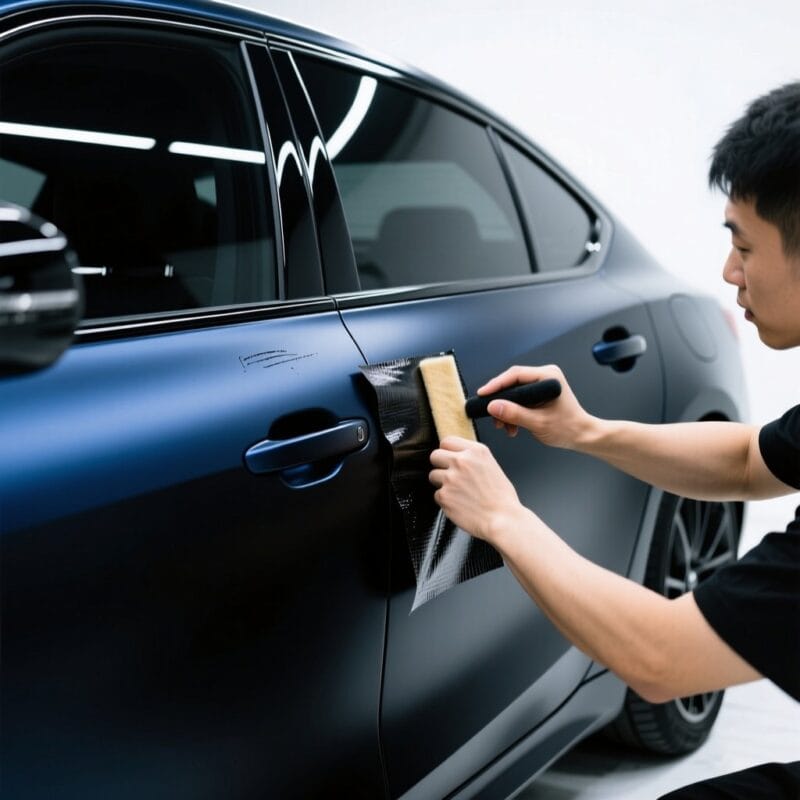
Satin navy black behaves like most premium cast and TPU films, but a few habits protect the finish:
- Prep the paint — decontaminate, clay, and polish first, because whatever is under the film stays there.
- Install in a controlled bay between roughly 18–24°C; cold film is stiff and hot film is floppy.
- Use felt-edged squeegees only. Bare plastic edges can burnish satin texture into a shiny streak that never comes out.
- Post-heat stretch areas to around 90–100°C to set the memory, per standard TPU film installation practice.
- Wrap edges where possible. On a dark satin color, a lifted edge reads as a bright line from ten feet away.
For fleets, the same film logic scales: fleet paint protection film in a uniform dark satin tone also conceals road grime between washes, which keeps vehicles presentable with less labor.
Valuable Advice From the Installation Bay
A few things shops learn the hard way:
- Care products matter. Use pH-neutral shampoo and satin-specific detailers. Regular gloss sealants will create shiny patches on a matte surface.
- Pressure washing: keep the nozzle at least 30 cm back and avoid spraying directly at edges.
- Metal applications: navy black film is not only for cars — installers apply satin color film to motorcycle tanks, laptop lids, elevators, appliance panels, and brushed-metal trim in architectural projects. On metal, surface prep shifts from clay-bar to isopropyl wipe-down, and the film acts as both restyling and a sacrificial layer against scratches.
- Stock planning for resellers: satin navy black sits in the steady middle of the color market — it is never the trendiest shade and never the dead stock. Distributors pricing this color typically see it hold value year-round; ask any supplier for their reorder data and this color tends to appear in the top tier of repeat SKUs.
Not All Film Is the Same
Two rolls can carry the same color name and perform like different products. The differences live where you cannot see them: adhesive formulation, TPU purity, pigment dispersion, top-coat chemistry, and the QC behind every batch. A film from a manufacturer with in-house coating lines and batch testing will lay flatter, heal more reliably, and remove cleanly years later. A bargain roll often does the color right and everything else wrong.
That is why Shimao builds its color PPF programs around verified material data sheets and batch traceability — buyers should demand the same from any manufacturer or supplier they evaluate, in this color or any other.
Related Finishes Worth Linking
If navy black is on your shortlist, these pair naturally with it in a catalog or a build:
- Satin black and true matte black films for two-tone builds
- Color PPF in gloss metallic navy for clients who want the same hue with reflections
- Clear satin PPF for preserving a factory matte finish
- Windshield protection film to complete a full-vehicle protection package
FAQ
How does a satin navy black film compare with gloss in maintenance?
Satin hides swirls, fingerprints, and light wash marks far better than gloss black. Maintenance is simpler — pH-neutral wash, no polishing — though you should use satin-safe detailers rather than gloss sealants.
Can it be removed later without damaging paint?
Yes. Quality color PPF and cast wrap films remove cleanly with heat within their rated service life, leaving OEM paint in the condition it was in when covered. Removal outside that window or over repainted panels carries more risk.
What does it cost compared with standard wrap vinyl?
Color PPF generally prices at a multiple of cast vinyl — expect roughly 3–5× per square meter depending on brand and thickness — because you are buying TPU impact protection plus the color, not just the color.
Is there a difference between the ECH15 code and other navy blacks?
ECH15 is one brand’s shade reference. Other manufacturers produce their own navy black formulations; tones are close but not identical, which is exactly why physical samples matter before a job.
How long does the color last outdoors?
Premium color PPF carries manufacturer warranties in the 5–10 year range for outdoor exposure with UV-stable pigments; cast vinyl wraps typically rate 3–5 years. Confirm against the current TDS.
Can I buy single rolls, or do I need container volume?
Most suppliers ship stock navy black shades by the roll for shops, while custom OEM tones carry a per-color MOQ. Shimao supports both small-lot orders for installers and private-label volume for distributors — reach out via www.smwrapfilm.com for current pricing and availability.
Satin navy black rewards buyers who check the details — sample first, verify the batch, and source from a manufacturer that can prove its material data. For samples, OEM color matching, or wholesale programs, contact Shimao and the team will walk you through the options.
