
Window Film Guide
Dyed vs Carbon vs Ceramic Tint: What Really Changes
Sep
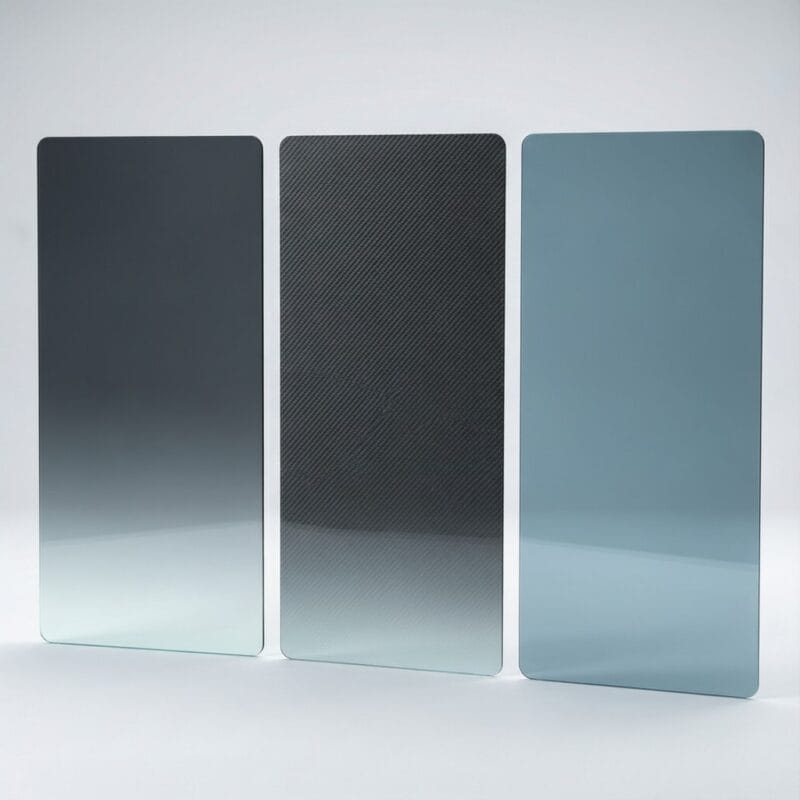
Quick answer: dyed, carbon and ceramic are three market positions, not three shades. Dyed opens the price ladder, carbon carries daily volume, and ceramic earns the premium through measured heat rejection and non-metallic construction. What actually changes between tiers is heat control, shade stability over years, optical clarity, landed cost and warranty structure — not VLT alone.
Before comparing sample cards, define what an upgrade is supposed to deliver:
- where the film sits on heat control;
- how well the color holds over years, not months;
- optical clarity;
- landed cost;
- the story your sales team can tell;
- warranty structure;
- the role each product plays inside your film line.
The Quick Version: What Does an Upgrade Really Buy You?
Moving from dyed to carbon buys positioning: better shade stability, a cleaner black, and a value story that holds up in front of a customer who is not only shopping on price. Moving from carbon to ceramic buys heat control and technical credibility, which is where the premium price gets earned. Visual darkness barely changes at a similar VLT.
One honest caveat: these are market tendencies, not performance guarantees. A well-built dyed film will embarrass a cheap film wearing a fancy name. Always test samples, check the data sheets, and judge a supplier on whether the next batch matches the last one. It is the same discipline we apply across Shimao’s film portfolio — whether the conversation is window film or the ongoing debate over TPU vs TPH PPF, construction and consistency beat category labels every time.
Why are darkness and technology two different conversations?
If you take one thing from this article, make it this: VLT describes how dark the glass looks, not how much heat it rejects. Every tier — dyed, carbon and ceramic — can be produced in light, medium and dark shades, so the shade card tells you what the glass will look like and almost nothing about the technology laminated inside it.
VLT tells you the shade, nothing else
VLT stands for Visible Light Transmission — simply how much visible light gets through the filmed glass. Higher number, lighter look. Lower number, darker look. Every category — dyed, carbon, ceramic — can be produced across light, medium, and dark shades. So reading VLT tells you what the glass will look like. It tells you almost nothing about which technology is inside.
A dark film is not automatically a cool cabin
Buyers constantly line up a very dark dyed sample against a lighter ceramic one and draw conclusions. Don’t. Blocking visible light and managing total solar energy are related, but they are not the same measurement. A lighter ceramic film can reject more total heat than a dark entry-level film — which is exactly why lighter ceramic shades sell so well in premium and visibility-regulated markets.
Test like-for-like, or don’t test at all
A comparison is only worth what you control for. Two films tested on different glass, at different shades, or on different days produce numbers nobody can defend. Hold these four variables constant before accepting any performance claim from a supplier:
- comparable VLT;
- identical glass type and thickness;
- one agreed test method;
- the same installation environment.
Dyed to Carbon: What Moves?
This is usually the first real upgrade a distributor makes, and it reshapes how the product is positioned, sold, and expected to age. Carbon replaces the dye load with carbon particles, so the black stays neutral instead of drifting purple, and the warranty conversation moves from how long it takes to fade to whether the next batch matches the last one.
Beyond shade and privacy
Dyed film earns its place as the accessible option: basic privacy, a darker glass look, entry promotions, and price-sensitive volume. There’s real value in that. In markets where the buying decision comes down to price and appearance, a well-run dyed line is a legitimate business, not an apology. Carbon shifts the story to the middle of the ladder: a cleaner, more neutral black, balanced everyday performance, a structured shade program, and — crucially — a sales pitch customers believe for more than one summer.
Color stability becomes part of the pitch
Here’s where honest sourcing matters. Not every dyed film is built the same. Dye chemistry, coating discipline, and production consistency vary enormously between factories, so flatly claiming “all dyed film fades” is lazy and usually wrong. Evaluate instead:
- dye quality and construction;
- batch-to-batch shade consistency;
- accelerated-weathering and anti-fading data where available;
- warranty wording.
Carbon’s particle-based color makes a stable black appearance much easier to promise, which is why it tends to become the core product for installation shops and regional distributors. Ask any film supplier for an anti-yellowing style weathering test on whichever series you are pricing — window film or PPF top coat, the principle is identical.
Carbon becomes the volume anchor
For many businesses the pattern is the same: dyed holds the entry price point, carbon carries the daily volume. Carbon threads the needle between the two objections every counter hears — “I just want the cheapest option” and “I want maximum heat rejection” — without asking the customer to pay the ceramic ticket.
“I just want the cheapest option.”
“I want maximum heat rejection.”
Carbon serves the customer in between — better product, better story, without the premium ceramic ticket.
Where does the sale change character from carbon to ceramic?
This step changes the technical and commercial conversation more than the first one did. Carbon still sells on appearance and price; ceramic sells on measured solar performance. The buyer stops comparing shade cards and starts reading test reports, and that shift in what is being compared is the real boundary between the two tiers.
Heat control takes center stage
Ceramic occupies the top heat-control position in a three-tier structure. The pitch moves away from darkness entirely and toward solar performance data, cabin comfort, optical clarity, and non-metallic construction (no signal interference — a genuine talking point with modern vehicles). But “ceramic” is a label, not a certificate. Real-world performance depends on pigment dispersion, film construction, coating quality, adhesive, VLT, and the conditions under which it was tested. Compare actual series with actual data, never category names.
The conversation gets more technical
Carbon sells with a sentence: clean black look, balanced performance, sensible price. Ceramic needs a paragraph — performance figures, comfort benefits, low-reflectivity, documentation. Your installers have to understand that paragraph before they can deliver it, and your distributors need sales materials that match the test reports. A premium sticker with no supporting data will not hold a premium price for long.
Pricing and margin restructure
Yes, ceramic costs more to buy. Done right, it also returns more per installation, provided the premium is backed by data rather than a label:
| Element | What changes at ceramic level |
|---|---|
| Retail price | Supports a higher ticket |
| Package | Fits a genuine premium bundle |
| Differentiation | Separates you from low-cost importers |
| Upsell path | Creates a clear “step-up” from carbon |
| Margin | Higher return per installation |
That higher price only survives if the product has a reason to exist. Before stocking a ceramic line, you should be able to answer: what exactly improves, how was it tested, how does it differ from the carbon series, why should the shop carry it, and why will the end customer pay more? SAE International’s published glazing and materials standards and NIST’s public polymer data are the neutral references to cite when you answer those questions.
Why Prove It Small Before You Scale?
Don’t jump from a sample kit to a full container. Pilot first. Take one pallet or a short production run, put it into two or three installer accounts, and watch three things: how it handles on the glass, how it sells, and whether claims or shade complaints appear. A few weeks of real-world feedback costs far less than a warehouse full of the wrong film. Once the pilot holds — shade matching batch to batch, installers happy, no warranty noise — then scale the order. Any serious film manufacturer should welcome this approach rather than resist it; at Shimao we build OEM and ODM programs around it regularly.
Which Difference Matters Most in the Market?
It depends where you sell. Across the export markets we serve, three factors decide which tier carries the volume: heat-control position, price and margin architecture, and long-term confidence in the supply. Local tinting regulation decides which shades can be sold at all, so check that before the rest.
1. Heat-control position
The clearest commercial dividing line. Dyed opens the price ladder, carbon balances it, ceramic owns the top. This matters most in hot-climate regions, high-sun markets, long-distance driving cultures, premium vehicle channels, and shops selling full-vehicle packages.
2. Price and margin architecture
The three tiers form a natural price ladder — and a healthy ladder stops your team from selling everything on VLT or roll price alone. Each level needs its own sales role, price, warranty position, upgrade reason, and target customer.
3. Long-term confidence
Customers remember how the film looks in year three, not year three weeks. Shade stability, documented weathering performance, and a supplier who ships consistent product are what turn a first order into a five-year relationship. It’s the same logic behind questions like how long does paint protection film last — buyers increasingly plan around total lifespan, and a PPF thickness guide or spec sheet only matters if the factory behind it is consistent.
What are the frequently asked questions?
Does a darker film block more heat?
Not necessarily. Darkness describes visible-light transmission, while heat rejection depends on the film’s total solar-energy performance. A lighter ceramic film can outperform a darker dyed film on total solar energy rejected, which is why premium markets buy light ceramic shades.
Is carbon film worth the step up from dyed?
For most sellers, yes. The stable black shade and the stronger mid-market story justify a modest price increase and reduce fade-related complaints. Carbon also gives your counter staff a performance argument that does not depend on selling the darkest shade on the card.
Is every ceramic film the same?
No. Dispersion quality, construction, adhesive and test conditions vary widely between factories, so the word on the box proves nothing. Judge the series by its data sheet: total solar energy rejection, VLT, IR rejection and accelerated weathering results at the same tested shade.
Should I import all three tiers at once?
Usually not. Start with the tier that matches your market, run a pilot with local installers, then extend the ladder once demand is proven. A full container of the wrong tier costs more than the margin a complete range would have added in the same period.
Building a dyed, carbon, and ceramic ladder around your own brand? Talk to Shimao about OEM and ODM film programs — sample requests and pilot-run details are available at www.smwrapfilm.com.
Where Do the Reference Numbers Come From?
Every figure quoted above comes from a supplier technical data sheet and, where a test method is involved, from a published standard. The notes below are the checklist we use when a distributor asks how a series was measured, so the same questions can be put to any competing factory before a container is booked.

Specifications in this guide follow window-film practice: VLT bands of 5–70 %, total solar energy rejection quoted at the tested VLT, and ceramic construction defined by non-metallic pigment dispersion per manufacturer technical data sheets (TDS). Verify every value against the supplier TDS before a bulk order.
Typical wholesale margins: a 20–40 % distributor mark-up over factory price is the industry norm rather than a premium. Treat it as a planning band and confirm the real margin structure, MOQ and freight terms against the written quotation.
Reference bands used by the industry: automotive tint thickness 1–2 mil (25–50 µm), roll width 1.52 m, installation temperature 15–30 °C, shelf life 12–24 months at 18–25 °C, and written warranties commonly 3–10 years on ceramic series. All are TDS-level facts worth re-checking per supplier.
Reference material: SAE International publishes the automotive glazing and materials standards; NIST maintains public polymer and materials reference data.

Pingback: Architectural Window Film Guide: Types and Metrics